How modern technology helps improve road safety
Car2X improves road safety and is ✓ connected, ✓ predictive and ✓ driver-assistive. Find out more now.
By the 2026 World Cup, the IoT will have become the invisible driving force: it can help to intelligently manage stadiums, transport, services and security – in real time.

At the 2026 FIFA World Cup in North America, with venues across the USA, Canada and Mexico, sporting excellence will meet digital infrastructure on a massive scale. With 48 teams, 104 matches and venues across the USA, Canada and Mexico, the tournament presents enormous challenges for organisers, cities and operators. Travel arrangements, stadium operations, fan services and security plans must work together seamlessly across national borders.
IoT technologies provide the digital foundation for this: networked sensors, real-time data and reliable mobile connectivity can help to manage traffic flows, make more efficient use of car park spaces, better guide visitor flows and ensure the stable provision of services in the stadium vicinity.
Major events such as the World Cup demonstrate that the IoT not only improves individual services, but also reliably connects complex infrastructures – from transport and building management to security and the fan experience.
Global IoT connectivity, together with international partner and roaming networks, enables devices, platforms and services to be connected across borders. Businesses benefit from a solution that is simple, secure, flexible and globally scalable – from smart car parks to intelligent energy management.
The first IoT solutions are already in use at the stadium several hours before kick-off. Ground sensors on the pitch monitor moisture levels and sunlight and transmit the data to the cloud via mobile networks. Using this information alongside up-to-date weather data, the groundsman can water the pitch as required. Meanwhile, autonomous mowers ensure the grass is cut to the correct length. To ensure the smart service vehicles stay on track at all times, they use high-precision positioning based on mobile and satellite data. The lines for the upcoming match are then freshly marked out – also by a self-driving robot.
Tens of thousands of fans need to be catered for from the moment they enter the stadium right through to the end of the match. Drinks, snacks, fan merchandise and technical equipment therefore arrive in the underground storage areas well in advance. Goods reception is managed via IoT sensors: arriving pallets are automatically scanned and collected by self-driving forklifts; autonomous transport vehicles take the goods to catering areas, sales stands and service points once they have been unpacked.
The 2026 FIFA World Cup will be jointly hosted by the USA, Canada and Mexico. For fans, this means long distances, complicated travel arrangements and high expectations of digital services.
For event organisers, cities and operators, reliable connectivity is therefore a key factor for success. IoT solutions must be easy to integrate, secure in operation, flexibly scalable and available worldwide.
Global IoT connectivity enables devices, platforms and services to be connected across borders – from car park management to visitor guidance around the stadium.
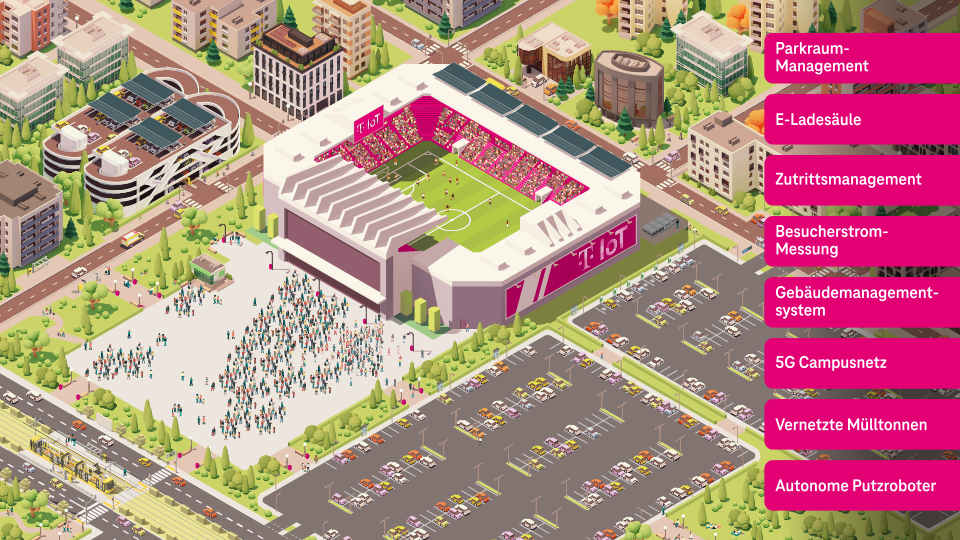
Many fans travel to the stadium by car, shuttle bus or public transport. Especially at major events such as the FIFA World Cup, the stadium experience therefore begins long before kick-off. IoT-based smart parking solutions help to manage traffic flows more efficiently and reduce the time spent looking for a parking space.
One example of this is Cleverciti. The company uses AI-powered sensors and IoT connectivity to identify vacant parking spaces in real time and allocate them digitally. Visitors can be directed to available spaces more quickly. This reduces traffic caused by people searching for a space, congestion and CO₂ emissions around event venues.
Electric vehicles can also be seamlessly integrated into car park management systems. Fans can reserve parking spaces, including those with available charging points, before they arrive. The stadium or event app provides directions directly to the appropriate parking space. Once on site, the charging process starts automatically following digital authentication – billing and charging time management are handled in the background via connected systems.
Deutsche Telekom IoT provides the connectivity needed to make such solutions possible – even when large numbers of people are using digital services simultaneously in the vicinity of the stadium.
In the car park and around the stadium grounds, connected LED systems automatically adjust their brightness depending on the lighting conditions and the number of visitors. The stadium’s outdoor lighting is also controlled as required using IoT sensors. This enables operators to reduce energy costs whilst improving safety and wayfinding.
Lichtwart is another example of how modern IoT infrastructure helps to operate buildings more efficiently. The company connects lighting, energy management and building services via smart IoT platforms. Sensors collect consumption data in real time, detect anomalies at an early stage and help to use energy efficiently – a key factor for sustainable large-scale events with high energy requirements.
In addition, autonomous service vehicles clean buildings, solar panels, glass surfaces and outdoor areas – ensuring that the infrastructure can be run efficiently even between match days. IoT technologies thus form the basis for the stadium of the future.
Shuttle buses and autonomous shuttles can transport fans from car parks, train stations or central transport hubs to the stadium. The vehicles use LiDAR technology, cameras and precise positioning data to manoeuvre safely around the site. Precise Positioning also helps them navigate accurately to entrances, pick-up points and accessible access points.
At the entrance, fans scan their digital tickets. Smart visitor flow analytics help guide visitors safely and efficiently through entrance areas, levels and corridors.
Aggregated and anonymised movement data can – provided it is permitted by regulations and complies with applicable data protection requirements – help to better understand visitor flows and identify bottlenecks at an early stage. Digital signage and apps support targeted visitor guidance.
Using the app, fans can find the nearest fan shop, the quickest route to their seat or the shortest route to accessible facilities. Payment is made via smartphone using smart ticketing systems. This transforms a series of individual digital touchpoints into a connected stadium experience – from the car park to the seat.
Simply fill out the contact form – we’ll get back to you as soon as possible.
The operator’s building management system collates data from thousands of IoT sensors distributed throughout the stadium. This intelligent system regulates lighting, ventilation and energy consumption according to demand and coordinates maintenance and cleaning processes. This enables resources to be used more efficiently and operating costs to be reduced.
5G lays the groundwork for real-time digital stadium experiences. High-performance mobile infrastructure, network densification and private 5G solutions (5G campus networks) can help prepare stadiums for high data volumes and business-critical applications.
Even at high capacity, 5G can help to deliver digital services more reliably and efficiently. For example, it can reliably support mobile applications, digital fan services and real-time information.
Once the final whistle has blown, the priority is to ensure that all spectators leave the stadium safely. Video-based analysis and other sensor data can assist security and emergency response teams in this task. Networked emergency exit signs, defibrillators, smoke detectors, first-aid kits and fire extinguishers provide additional safety. If a device needs replacing, an alert is immediately sent to the security team.
Apps and digital wayfinding systems help visitors find the quickest route back to the car park, shuttle bus or train station.
When tens of thousands of people gather to celebrate a football festival, a corresponding amount of waste is generated. Connected bins automatically report their fill levels and are emptied as needed. Autonomous cleaning vehicles clear pathways and spectator areas efficiently and in an environmentally friendly manner. Other service robots collect rubbish and cigarette butts around the stadium grounds – ensuring that everything is ready again in time for the next match.
The 2026 World Cup demonstrates just how important connected infrastructure is for the successful running of complex large-scale events. Wherever large numbers of people, systems and services come together, connectivity becomes the invisible backbone of the experience. Telekom IoT helps companies to manage such solutions easily, operate them securely, scale them flexibly and roll them out worldwide.

Our IoT solutions turn buildings into smart, sustainable, and comfortable environments that adapt to the needs of their users.

Having been with Telekom since 2008, Ümit possesses a comprehensive understanding of various facets of the Internet of Things. He has a keen interest in the digital transformation of the business world. On this blog, he shares insights into the latest developments and trends in the IoT sector that provide genuine value to customers.
Car2X improves road safety and is ✓ connected, ✓ predictive and ✓ driver-assistive. Find out more now.
IoT devices are revolutionising the business world: with real-time data and predictive maintenance, they not only improve production processes but also open up entirely new business opportunities and potential for innovation.
Connected cars link vehicles, drivers and infrastructure in real time – for greater ✓ efficiency, ✓ safety and ✓ comfort. Find out more on our blog now.