To the page content
T IoT

5G RedCap for energy suppliers: When does the leaner 5G option makes sense?

Modern energy supply today involves far more than just individual smart meters. Gateways, control units, charging points, network sensors and decentralised energy systems must also communicate reliably. However, with every additional device, the question of the right connectivity becomes more complex: some applications transmit only a few measurement values, whilst others need to communicate more frequently or be integrated directly into operational processes. This is precisely where 5G RedCap comes in. The question is: for which components does this technology make sense, and where are NB-IoT, LTE-M or standard 5G the better choice?

Geöffneter Schaltschrank mit Smart-Meter-Gateway und vernetzten Komponenten vor Funkmast und Energieinfrastruktur.

In brief

  • 5G RedCap is particularly of interest for moderately complex IoT devices, such as gateways, routers, control units or monitoring components.
  • Simple meter and sensor data is often best handled by NB-IoT or LTE-M.
  • What matters is not the latest technology, but the specific combination of data rate, latency, power consumption, location and service life.
     

What is 5G RedCap?

5G RedCap stands for ‘5G Reduced Capability’ and refers to a scaled-down version of 5G designed for applications with moderate requirements in terms of data rate, latency and energy consumption. The technology is more streamlined than traditional 5G, yet significantly more powerful than many low-power IoT technologies. It is therefore designed for devices that are intended to benefit from the latest 5G features without having to integrate the complexity of a full 5G module.

The technical advantages of 5G RedCap

5G RedCap utilises a simplified 5G profile for connected devices. Compared with conventional 5G devices, RedCap-enabled devices require less antenna technology, less signal processing and lower power reserves. This means they can be more compact, more energy-efficient and more cost-effective.

From a technical perspective, 5G RedCap is also of interest as a future-proof solution for applications that are currently often implemented using LTE Cat 4 (an LTE device category for higher data rates). 5G RedCap can fulfil a similar role in the mid-range performance category, but is based on 5G. Another difference lies in the device design: whilst typical LTE Cat 4 set-ups are designed for two receiving antennas, 5G RedCap can, depending on the implementation, also be used with just one receiving antenna. 

This offers energy suppliers four key benefits:

  1. Simpler device integration: 5G RedCap reduces the technical requirements for connected devices. This can simplify integration into gateways, routers, control boxes or monitoring units, and make deployment across larger fleets of devices more cost-effective.
  2. Greater performance than low-power technologies: 5G RedCap is suitable for applications that communicate more frequently, transmit more status information or are more closely integrated with back-end systems. This makes the technology an attractive option when simply transmitting measured values is no longer sufficient.
  3. Long-term 5G outlook: 5G RedCap-enabled devices may, in the future, benefit from 5G SA features such as network prioritisation, time synchronisation or targeted resource management. This is particularly relevant for energy infrastructure, which is intended to be reliably integrated into operational and control processes in the long term.
  4. Greater planning certainty for new generations of devices: 5G RedCap provides a technical foundation for IoT devices that are intended to remain in the field for many years and be integrated into modern 5G networks in the long term. This helps energy suppliers to deploy new gateways, routers or control components 

What is a gateway?

A gateway is the connecting unit between devices in the field and central systems. It collects, aggregates or translates data and transmits it to backend platforms, control centres or cloud applications. In the energy sector, for example, gateways can connect meters, sensors, control units, charging points or decentralised energy systems. The more devices, data points and control processes are brought together, the more important reliable connectivity, availability and secure data transmission become.

NB-IoT, LTE-M, 5G RedCap or 5G: Which technology is right for which situation?

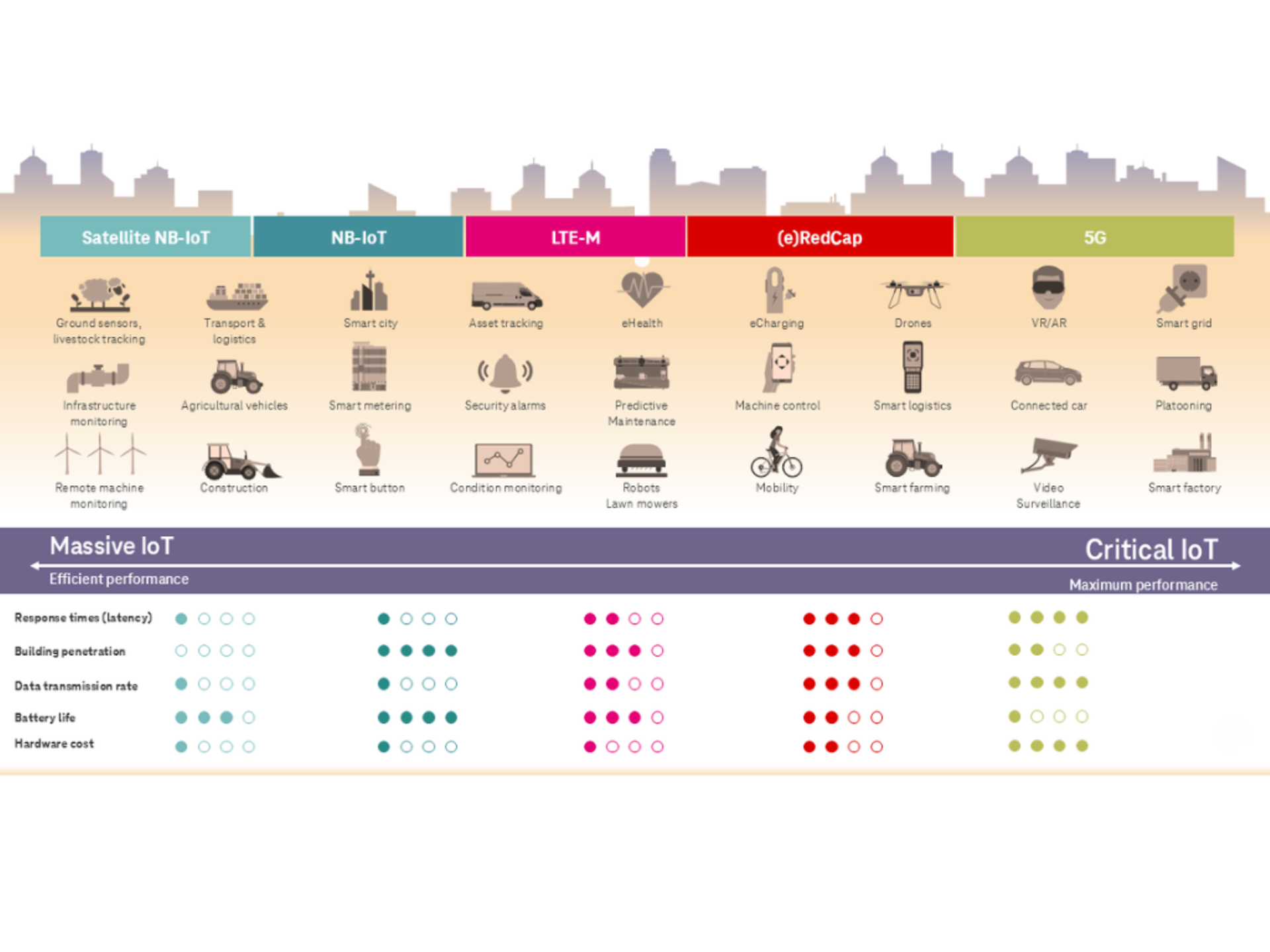
It is not the buzzword that determines which technology is suitable, but the specific requirements profile. For energy suppliers, the key factors are data rate, latency, energy consumption, building penetration, equipment costs, location and service life. It is therefore worth taking a look at the typical areas of application for each technology:

TechnologyParticularly suitable forRole in the energy sector
Satellite NB-IoT/NB-NTNSmall amounts of data at locations without mobile phone coverageRemote monitoring of decentralised sensors or tracking solutions outside terrestrial network coverage
NB-IoTSmall data volumes, long battery life, deep penetration into buildingsSimple meter readings, sensors in basements or hard-to-reach areas
LTE-MModerate data rates, mobility, greater flexibilityMobile assets, simple firmware updates, more flexible measurement applications, meters or sensors with higher data volume requirements
5G RedCapMedium data rates, lower latency, reduced 5G complexityGateways, control units, communication routers, network sensors, monitoring
5GHigh data rates, very low latencyData-intensive or particularly time-critical applications


The IoT connectivity mix at a glance

Infographic comparing IoT network technologies by use case and technical requirements.

Smart metering in practice: Where 5G RedCap comes into play

Smart metering is a particularly good example of why the choice of the right connectivity needs to be considered on a case-by-case basis. A simple digital meter usually transmits small amounts of consumption data, often from basements or hard-to-reach areas of a building. In such cases, NB-IoT or LTE-M are often the sensible choice, because energy efficiency, building penetration and cost-effective operation are more important than high data rates.

The situation is different for smart meter gateways, communication routers, control units and grid-side monitoring components. These aggregate data, transmit status information more frequently, receive control commands or are more closely integrated with back-end and operational processes. The following overview shows how the requirements differ for each smart metering component:

A component of smart metering Typical requirements The role of 5G RedCap 
Simple digital counter Small data volumes, long service life, good penetration through buildings The recommended network technology is NB-IoT 
Sensors in a building or network Regular readings, energy-efficient operation The recommended network technology is LTE-M (5G RedCap is recommended for more frequent or extensive communication) 
Smart Meter Gateway Secure data aggregation, backend integration, higher availability A suitable application for 5G RedCap, as gateways offer more functionality than simple meters and, at the same time, do not usually require full 5G  
Communications router Connecting multiple devices, data transfer to backend systems A possible option for 5G Redcap where maximum data rates are not a deciding factor 
Control box Control commands, status messages, lower latency 5G Redcap is recommended for situations where higher standards of availability and response time are required 
Grid-based monitoring More frequent status data, integration into operational processes 5G RedCap is useful for data-intensive or time-critical monitoring 

Is smart metering compulsory in Germany?

Yes, the smart meter roll-out is regulated by law in Germany. Metering point operators with primary responsibility are required to install smart metering systems in defined cases where installation is mandatory, such as where annual electricity consumption exceeds 6,000 kWh. For energy suppliers and metering point operators, this means that it is not only the roll-out that is relevant, but also secure, scalable connectivity for gateways, control boxes and back-end connections.

Further use cases for 5G RedCap among energy suppliers

Network sensors and local network stations

Network sensors measure voltage, load, temperature or operating conditions. When this data is transmitted more frequently and integrated more closely into monitoring or control processes, the demands placed on the connection increase. 5G RedCap can be a relevant solution here when traditional low-power technologies are no longer sufficient, but full 5G would be over-specified for the data volumes and response times required. Local distribution substations and transformers can also benefit from a more streamlined 5G connection, for example for condition monitoring and predictive maintenance.

Charging infrastructure and load management

Charging points communicate with backend systems, billing, energy management and load management. For simple applications, LTE-M may be sufficient. However, if charging infrastructure is more closely integrated into dynamic control processes – for example, for load balancing or the integration of local energy sources – lower latency and more frequent status updates may become more important. This is precisely where 5G RedCap can serve as a suitable intermediate step: more powerful than traditional IoT connectivity, but leaner than full 5G.

Decentralised energy systems

Solar PV systems, battery storage, heat pumps and energy management systems are increasingly becoming part of a connected energy system. They need to be monitored, controlled and integrated into operational processes. 5G RedCap becomes particularly interesting when communication routers bundle several components and regularly transmit data to back-end systems. For such moderately complex applications, RedCap can provide a long-term 5G solution without the need to equip every system with full 5G hardware. 

Where 5G RedCap makes sense, and where it doesn’t

Whether 5G RedCap is a viable option depends primarily on the requirements of actual operations. The following criteria help to assess this:

5G RedCap is particularly suitable when:

  • devices need to transmit more than simple measurement data.
  • more frequent status updates are required.
  • devices are connected to a permanent power supply.
  • lower latency is relevant for monitoring or control.
  • gateways, routers, control units or monitoring devices need to be connected.
  • new device generations are planned as part of a long-term 5G roadmap.
  • existing LTE-based solutions are to be modernised over time.
  • devices need to be integrated into operational processes, rather than simply transmitting data.

5G RedCap is usually less suitable when:

  • only small amounts of data need to be transmitted.
  • maximum battery life is a key requirement.
  • deep indoor or basement coverage is more important than data rate.
  • NB-IoT or LTE-M already cover the use case reliably and cost-effectively.
  • device costs need to remain particularly low.

It is also important to consider market readiness. 5G RedCap is strategically relevant, but its actual deployment depends on network support, the range of end devices, modules, certification and the effort required for integration. For energy suppliers, the decision should therefore always be based on specific use cases: What data is generated? How often does communication take place? How critical is latency? Where is the device located? How long will it remain in the field? And what is the long-term network strategy? 

A look to the future: eRedCap as the next stage in 5G IoT

With eRedCap, the next stage of development is already on the horizon. In future, the technology is set to provide a further intermediate step between LTE-M and 5G RedCap. This would enable even simpler or battery-powered IoT devices to benefit from 5G standalone capabilities whilst achieving higher data rates than with LTE-M.

For energy suppliers, eRedCap is primarily a roadmap issue. Whilst 5G RedCap is currently of particular interest for gateways, routers, control units and monitoring components, eRedCap could, in the long term, bring further device categories into the 5G fold without requiring the complexity of RedCap or full 5G. 

5G RedCap complements the range of connectivity options in the energy sector

5G RedCap bridges the gap between NB-IoT, LTE-M and full 5G. For energy suppliers, the technology is particularly relevant in situations where devices need to do more than simply act as sensors, but do not require full 5G – for example, gateways, control boxes, network sensors or communication routers.

The specific use case determines which technology is suitable: device type, data profile, energy requirements, security requirements, location, budget and long-term roadmap. 5G RedCap does not replace NB-IoT, LTE-M or 5G, but complements them as a streamlined 5G option for the next generation of connected energy infrastructure. 

Similar use case or any questions?

Simply fill out the contact form – we’ll get back to you as soon as possible.

5G for IoT

Freeway at night from bird's eye view

5G for IoT

Autonomous vehicles, remote surgeries performed by robots, and smart grids – all of this is already being made possible today with 5G technology. 5G takes the Internet of Things to the next level, enabling high-performance, low-latency connections for applications that demand maximum speed and precision.

Potrait photo Annalena Rauen

Annalena Rauen

Marketing Manager IoT

Back in 2016, Anna worked on IoT topics at Deutsche Telekom for the first time. Since then, she has been supporting customer best practices in a wide range of industries – always focusing on the benefits that the Internet of Things can provide. Her IoT blogposts describe real use cases and the value these innovations add to market players, their business models, and even entire industries.

Curious? Find out more now:

Smart meter functionality: how intelligent measuring devices work

How much electricity, water, and gas do we actually use? And how can we reduce energy consumption? Two questions that companies must address in times of constantly rising energy prices. Smart meters could quickly provide answers in this case. Read more in this article!

Read article

IoT security: recognising and closing security gaps

In modern companies, more and more devices are communicating with each other in real time. However, the stronger the networking, the greater the attack surface, as every IoT device is a potential gateway into the company network. Find out here what risks exist and how you can protect your systems effectively.

Read article